For many people, summer reading means breezy, beachy books—romance novels, light fiction, and easy reads.
Not me.
Summer is when I finally have time to sink my teeth into the kinds of books that really get my juices flowing. I’m talking about real-life stories: memoirs, true crime, and stories about real people facing extraordinary circumstances. I’m fascinated by the tragedies and triumphs of other people’s lives, and especially by the ways people make sense of what happens to them.
I think my love of real people’s stories is one of the reasons being a psychiatrist is such a good fit for me. There’s nothing I love more than meeting real human beings and hearing their stories—the disappointments, the tragedies, the trauma, the unexpected twists and turns—and learning about the ways they have navigated the circumstances life has handed them.
My love of reading and discussing books eventually led me to start a book club for therapists last fall, in collaboration with the Montclair Therapist Network. We read and discuss memoirs with mental health themes, and it has been so much fun to have a community of other readers to share book recommendations with, debate books, and hear different perspectives and insights.
This summer, I happened to read several exceptional memoirs that all explored a similar theme: What happens when life hands you something you never expected, never asked for, and certainly didn’t deserve?
Interestingly, I didn’t plan for my summer reading to have a theme. It just happened.
One of these books was our book club’s summer selection, while the others were books I happened to discover at my local library. Yet each tells the story of someone who is dealt an extraordinarily difficult hand. Each protagonist experiences a period of falling apart, but eventually finds a way forward—through storytelling, community, travel, connection, or simply learning to accept what cannot be changed.
And perhaps most importantly, each discovers some form of resilience and purpose that might never have emerged without the adversity.
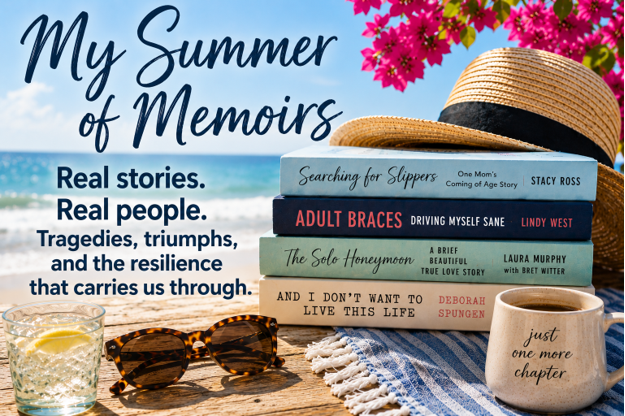
So here are my summer memoirs, along with my summaries, reflections, and ratings.
Searching for Slippers: One Mom’s Coming of Age Story by Stacy Ross
The Story:
Stacy Ross chronicles her journey parenting a child with borderline personality disorder. Along the way, she navigates the school system, the mental health care system, and her own deeply held belief that if she can just be a perfect mother, everything will be okay.
Eventually, she comes to a difficult realization: perfection is impossible, reality cannot always be controlled, and acceptance is often the key to finding peace. As her child becomes an adult, she also learns the importance of setting healthy boundaries.
Mental Health Themes:
Infertility, adoption, borderline personality disorder, the impact of mental illness on the family system, perfectionism, parenting, and setting boundaries.
My Thoughts:
Stacy Ross is not a professional writer, but a real person who bravely shares the challenges of parenting a difficult child. At times, the writing relies heavily on clichés, but once I got past that, I found myself appreciating the raw honesty with which she describes her experiences.
She writes openly about infertility, adoption, parenting a challenging child, and the impact all of this has had on her marriage, her family, and her own belief system.
Like so many of us, Stacy is a perfectionist who believes that if she can just control enough variables, life will turn out the way it is supposed to. But life keeps throwing situations at her that she simply cannot control.
She also wrestles with a parenting dilemma that I suspect many parents can relate to: When do you step in and rescue your child, and when do you step back and allow them to experience the consequences of their choices?
That question becomes particularly complicated when your child is struggling with significant mental illness.
Rating: ⭐⭐⭐½ 3.5/5
Adult Braces: Driving Myself Sane by Lindy West
The Story:
Lindy West is the author of the earlier memoir Shrill, which chronicled her experiences as a plus-size woman navigating adulthood, career, relationships, and the expectations placed on women’s bodies.
Shrill became a major success and was adapted into a Hulu series—which, coincidentally, has been picked up by Netflix and has become my own summer nighttime indulgence, much like a bowl of ice cream.
Adult Braces picks up with Lindy on the cusp of 40. Despite her professional success and public image as a woman who is confident and comfortable with her unconventional beauty, she continues to struggle privately with insecurity, anxiety, and depression.
Her inner world is in turmoil: her father has died and her marriage is struggling. Meanwhile, the world around her feels increasingly chaotic. America is politically divided, and the planet is reeling from a global pandemic.
In response, Lindy—a self-professed codependent—decides to take a solo cross-country road trip. Along the way, she explores the conflicts and schisms in America, her marriage, and her own mind.
Mental Health Themes:
Depression, anxiety, grief, codependence, infidelity, ADHD, and polyamory.
My Thoughts:
Lindy West tackles some incredibly heavy subject matter, but she does so with such humor that the book remains remarkably readable—and at times genuinely hilarious.
One subplot that particularly piqued my interest was Lindy’s experience seeking an adult ADHD diagnosis. Instead of receiving affirmation, she is dismissed as anxious and essentially told that she is too intelligent and accomplished to have ADHD.
As a psychiatrist who has made a career out of diagnosing and treating adult ADHD, I found this infuriating. Unfortunately, I also know that Lindy’s experience is not unusual. I hear similar stories from high-functioning, midlife neurodivergent women in my practice all the time—women who have spent decades compensating for their ADHD and are then told that their success somehow proves they cannot possibly have it.
Another fascinating subplot involves the evolution of Lindy’s marriage from a couple to a throuple. I hesitate to say much more because I don’t want to give away a major plot point, but I would love to hear other readers’ thoughts about Lindy’s decision to explore polyamory as a response to marital discord.
Rating: ⭐⭐⭐⭐ 4/5
The Solo Honeymoon: A Brief Beautiful True Love Story by Laura Murphy with Bret Witter
The Story:
Laura Murphy is a young woman in her 20s who seems to have it all: a promising legal career, an adoring fiancé, a charming home in Newfoundland, Canada, and two adorable dogs.
She is preparing for a cozy future involving marriage and children when tragedy strikes: her beloved fiancé, Devon, dies just weeks before their wedding.
Laura is devastated. She desperately needs time, space, and anonymity to grieve. In the depths of her depression, she makes an unconventional decision: she takes their European honeymoon alone.
Along the way, Laura discovers an unexpected community through TikTok, deepens her connection with Devon’s family, reconnects with the Italian town he loved, and discovers that she is far more resilient than she ever imagined.
Mental Health Themes:
Grief, loss, sudden death, premature widowhood, rebuilding a life after tragedy, solo travel, and the healing power of community and connection.
My Thoughts:
An incredible story of love and loss, beautifully written.
Part love story, part tragedy, and part travelogue, The Solo Honeymoon also explores something very modern: the role social media can play in grief and healing.
Laura experiences both the best and worst aspects of online community. She finds people who understand her unique circumstances and who accompany her through her journey, while also learning to navigate the inevitable downsides of sharing such a vulnerable experience publicly.
Ultimately, the book is a beautiful reminder that healing doesn’t necessarily mean “getting over” someone. Sometimes it means finding a way to carry your loss with you while building a life that you never imagined you would have.
Rating: ⭐⭐⭐⭐½ 4.5/5
And I Don’t Want to Live This Life by Deborah Spungen
The Story:
And I Don’t Want to Live This Life tells the true story of Nancy Spungen, the female half of the infamous “Sid and Nancy,” whose toxic relationship and untimely deaths became emblematic of the punk-rock movement.
But Nancy was much more than the punk-rock caricature.
As told by her mother, Deborah Spungen, the book chronicles Nancy’s short and tumultuous life, from her traumatic birth in 1958 through her murder in 1978.
What surprised me most was learning that Nancy was raised by a middle-class Jewish family in suburban Philadelphia. From an early age, she was an anomaly within her family—disruptive, impulsive, and increasingly difficult to manage.
Her parents repeatedly sought help from medical and mental health professionals but were often dismissed or blamed for Nancy’s behavior. Raising her became a private hell that few people around them could understand, yet her mother remained fiercely devoted to her as Nancy descended into a life of sex, drugs, and rock and roll.
Mental Health Themes:
Parenting a child with significant mental health and behavioral challenges, the impact of mental illness on the family system, parental guilt, boundaries, enabling, codependency, grief, loss, and rebuilding after tragedy.
My Thoughts:
This book was originally published in 1983 and would never have crossed my radar if it hadn’t been recommended by one of my colleagues as our book club’s summer selection.
Growing up in the 1980s and 1990s, I had heard references to “Sid and Nancy,” the Romeo-and-Juliet-like punk couple portrayed in the 1987 movie of the same name, although I never actually watched it. I had heard of Sid Vicious and the Sex Pistols, although I couldn’t name a single song by them. And I vaguely remember the duo being referenced in the early-2000s song “Butterfly” by Crazy Town.
But I knew almost nothing about Nancy herself.
The book was incredibly well written and deeply thought-provoking. As I read it, I constantly found myself asking—both as a parent and as a mental health professional—“What would I have done?”
At times, Deborah’s devotion to Nancy seemed almost as destructive as Sid’s, veering into enabling and codependency. Yet I found myself wondering: Would I have been able to turn my back on my own sick child?
That is what makes this book so difficult. There are no easy answers.
The mental health professionals described in the book were frequently dismissive, blamed the parents, and sometimes pushed the family away during their greatest moments of need. I would like to think that we have come a long way since the 1960s and 1970s—but I’m not always sure that we have come as far as we think.
This book was so powerful and deeply moving that I continue to think about it long after turning the final page.
In fact, I have so much more to say about it that I think it deserves its own blog post.
So stay tuned. This one is to be continued…
Rating: ⭐⭐⭐⭐⭐ 5/5
What I Took Away From My Summer of Reading
Although I never intended to create a themed summer reading list, these four memoirs ended up asking me many of the same questions:
What happens when life doesn’t turn out the way you expected?
What happens when your child becomes seriously mentally ill? When your marriage falls apart? When your fiancé dies before your wedding? When you realize that you cannot control the outcome, no matter how hard you try?
And perhaps most importantly: How do we find our way forward when there is no way to go back?
None of these books offers a simple answer. But all four suggest that resilience is not necessarily about being strong enough to withstand everything life throws at you.
Sometimes resilience looks like accepting reality.
Sometimes it looks like asking for help.
Sometimes it looks like setting a boundary.
Sometimes it looks like finding a community of people who understand.
Sometimes it looks like getting in your car and driving across the country.
And sometimes it looks like taking the honeymoon you were supposed to take with someone you loved—and discovering that you can still build a meaningful life afterward.
Maybe that’s why I love memoirs so much.
They remind me that behind every diagnosis, every family conflict, every tragedy, and every seemingly impossible situation is a real human being trying to figure out how to live their life.
And those are the stories I never get tired of hearing.
What have you been reading this summer? And if you’ve read any of these books, I’d love to hear your thoughts.